
Holy Longing
What Our Restlessness Is Telling Us


“One can find so many pains when the rain is falling.” -John Steinbeck
If Steinbeck’s quote is true, we Oregonians have laser-clear pathways to pain. And sometimes I do—even for fleeting moments. Clarity, the edge and shadow of pain, always felt as longing. This week, I was reminded of John O’Donohue’s notions around the experience. The late Irish poet wrote beautifully of longing as that which “quickens your soul with wonder” and as “divine urgency.” In the reckoning of O’Donohue, longing is inevitable—an essential part of this life and a dissatisfaction that bedevils us this side of the veil.
Longing as Divine Urgency: What John O’Donohue Understood
All of us ultimately long for the transcendent—for God (if you use that language) or for the ‘more than,’ whatever you call it; for all that is grander than ourselves and the rudiments of material existence. As John O’Donohue understood it, all longing is in some sense a longing after God or transcendence—for reuniting with our essence and spirit-origin. He wrote that “[t]here is a divine restlessness in the human heart. Though our bodies maintain an outer stability and consistency, the heart is an eternal nomad.”[1]
When Restlessness Is Actually Holy Longing in Disguise
At times, I feel this longing head to toe. It can be easy to mistake for distraction or antsy-ness. Once again I am that school girl desperate to escape from my desk into nature; or the boy whose body was made to move, desperate to run up and down the soccer field. When I feel this antsy-ness, I check social media too often, I indulge my wanderlust, I crave food. I struggle to get work done because I’m restless to create, to be outside, to let my mind wander, to rest and retreat from my compulsive productivity.
O’Donohue quite graciously recasts this itch as holy longing. He also reminds us it’s an itch that can’t totally be eased, which is generally the source of our pain. We will always have it, always feel it. In this life, we’ll always crave for ‘more than.’ Our longing-pain is the eternal in us beckoning us beyond striving and earning and maintaining. As creatures imbued with God, we have one foot in a life making incessant demands of us as producers and fighters, and one foot in the spirit world, where we know we are made for more. Shakespeare wrote of ‘immortal longings,’ and whatever he meant by this, it is an apt phrase for our predicament.

How Longing for the Transcendent Makes Mystics of Us All
At times when we catch glimpses of the more-than, of our nature as one with transcendence, or the Great Spirit, we all become mystics. A mystic is simply someone who understands that our access to God is direct, unmediated, because God is within us and within all things.
Rabbi Lawrence Kushner on What a Mystic Is
One of my favorite teachers of mysticism is Rabbi Lawrence Kushner. And in one of my favorite Kushner quotes, he explains it this way:
“I think what our generation seems to be living through is the realization that rationalism is only part of the answer. I think, I’m not the first one to notice this, that Auschwitz and Hiroshima were perfectly rational decisions and behaviors. So there’s this sense that religion has to be more than rationalism. And mysticism offers — it says, sort of like in the corner, ‘Psst, hey kid how would you like a direct experience of the divine? Would that help your religious life?’ And a lot of people discover that they’re mystics after all when they’re given that offer.
“…This is a definition of a mystic: ‘A mystic is anyone who has the gnawing suspicion that the apparent discord, brokenness, contradictions, and discontinuities that assault us every day might conceal a hidden unity.’ At times, our longing after that hidden unity makes us feel in this world of brokenness like homesick sojourners.”[2]
How Creativity and Other Gifts Connect Us to Our God-Nature
As an artist, I often experience my insatiable creative impulse as the strongest sign to me of this holy longing, of the homesickness that will never be satisfied this side of things. For others it is expressed in other ways. Our unique gifts are the things we contribute to putting back together the broken things. During our time here, that is what we do, what we can do. Our gifts are the ways we connect most powerfully to our god-nature, and we hunger for this realization, this union, in a way that can be painful.
[1] From O’Donohue’s book Eternal Echoes: Celtic Reflections on our Yearning to Belong.
[2] https://onbeing.org/programs/lawrence-kushner-kabbalah-and-everyday-mysticism/#transcript
If you liked this article, please leave me a comment below; I am interested in your perspective. To support my writing, please subscribe and share with a friend!
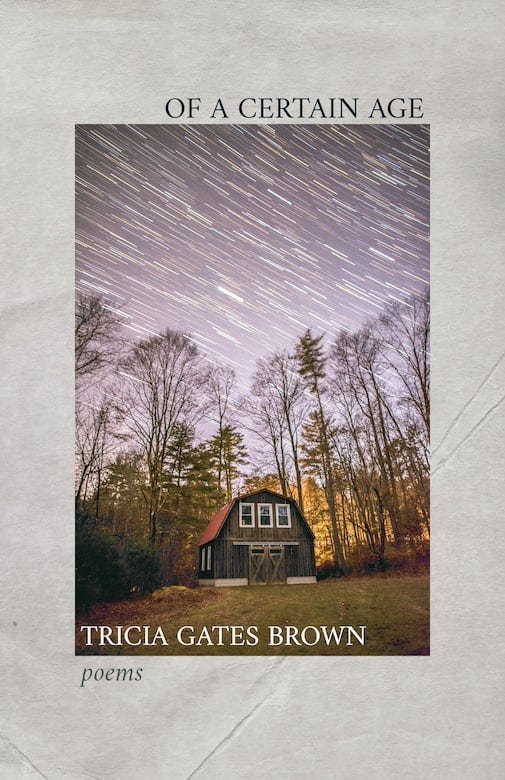
OF A CERTAIN AGE, A Poetry Collection, Now Available from Fernwood Press
Moving through sections that are roughly chronological—teens, twenties, thirties, forties, fifties—Of a Certain Age, explores the unfurling of a life, from loss of innocence to contemplation of death, from bemusement at life’s gaffes to bewilderment as life’s invariables slip away. Tricia Gates Brown reminds us to tune in—to the natural world, to the transcendent, to relationships, to the decades and epochs of one’s ordinary life, with wonder and courage. Reverence, at any age, is no where but here. To be released at major booksellers July 14, 2026.

Tricia Gates Brown is a writer/editor in Oregon’s Willamette Valley whose debut novel Wren won a 2022 Independent Publishers Award Bronze Medal. Her second novel, Finding Something to Love, will be published in 2027 by Vine Leaves Press. She publishes widely in literary journals and holds a PhD from University of St. Andrews in Scotland. Aside from writing, she creates art from the home she shares with her spouse and a bevy of beloved cats. Her first collection of poetry, Of a Certain Age, will be released by Fernwood Press on July 14, and her second, Blessings, Curses, is forthcoming from the same. Read more at https://triciagatesbrown.net .
What beautiful and hopeful observations. Ever since I was able to name my own mysticism, I have felt more at home in my heart and the world. More at peace with god.
The longing🤍